
Economics and AI

Economics and AI
AI Won't Replace Economists. It Will Need Them.
The AI revolution isn't a threat to economics graduates — it's the biggest opportunity of a generation. The skills you build here are exactly what the new economy demands.
Early-Career Earnings
Economics BA (ages 22–26)
Employers Rank Analytical
Thinking #1 Skill
Net New Jobs by 2030
(WEF Projection)
The Argument
Machines Compute. Economists Think.
AI is automating routine data tasks at an accelerating pace. But the jobs growing fastest require exactly what an economics education trains you to do: frame the right question, interpret results in context, weigh tradeoffs, and communicate insights that move decisions.
Causal Reasoning
AI can find correlations in seconds. It takes a trained economist to design the identification strategy, recognize confounders, and determine what a correlation actually means for policy or strategy.
Institutional Judgment
Markets, regulations, and incentives don't exist in a dataset. Economics teaches you how political and social institutions shape outcomes — context AI cannot learn from numbers alone.
Ethical Policy Design
Should we optimize for efficiency or equity? Who bears the costs of a policy? These are normative questions that require human values, not algorithmic outputs.
Strategic Communication
The most powerful analysis is worthless if no one acts on it. Economists learn to translate complex findings into arguments that persuade policymakers, executives, and the public.
The Evidence
What the Data Shows
AI is reshaping the labor market — but the direction favors those with the analytical, contextual, and communicative skills that define an economics education.
The Skills Employers Want Most by 2030
Share of employers who say each skill is growing in importance. Green = skills you build in economics.
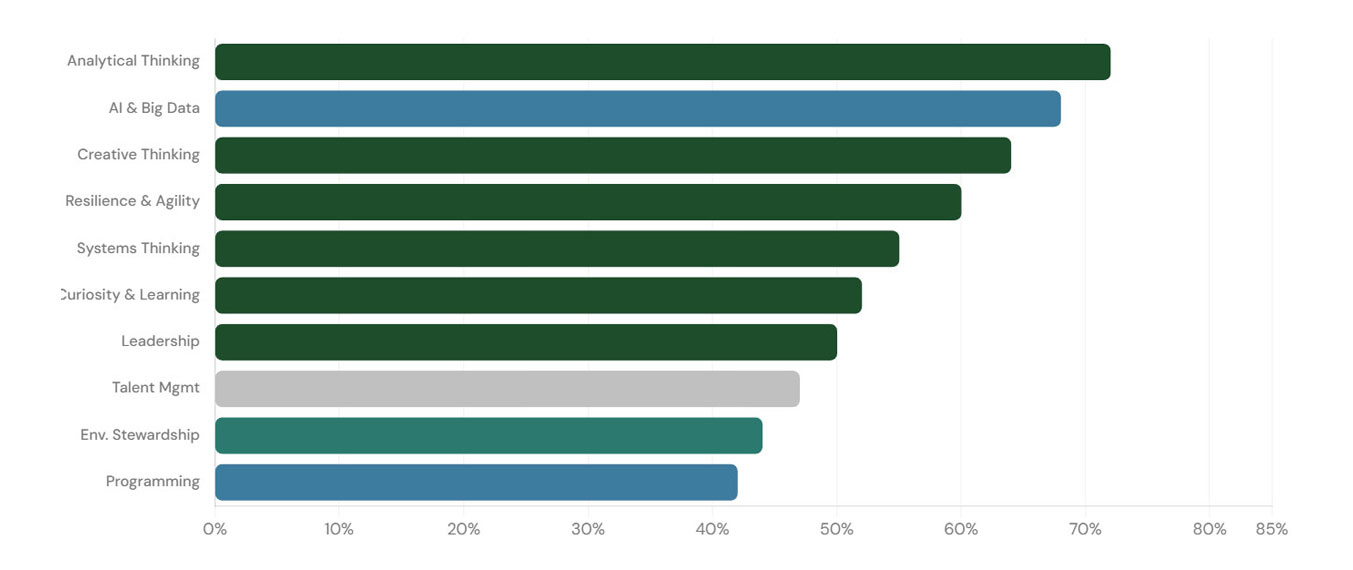
Source: World Economic Forum, Future of Jobs Report 2025. Green bars = core economics curriculum alignment.
AI Exposure ≠ AI Replacement
Economics graduates enter high-exposure occupations — but high exposure with high complementarity means AI amplifies your work, not replaces it.
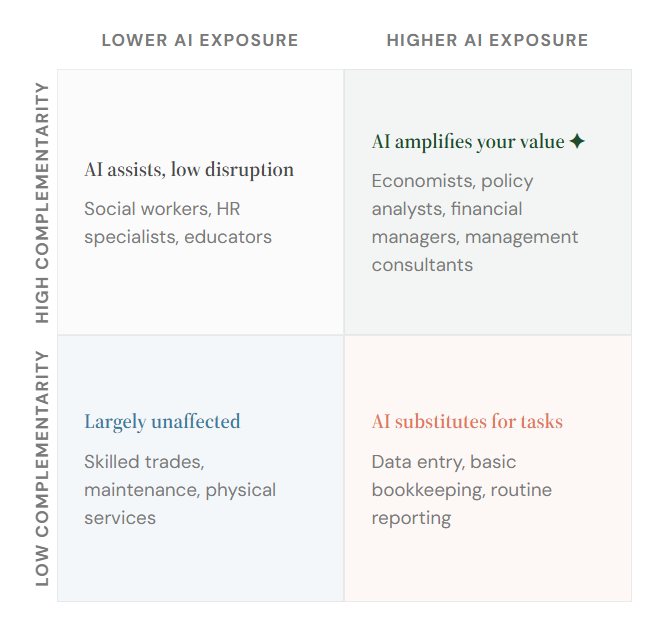
Not all AI exposure is bad. Researchers distinguish between jobs where AI replaces tasks and jobs where AI makes workers more productive. Economics graduates cluster in the green quadrant.
The Economics Earnings Trajectory
Economics vs. all-bachelor's median earnings by career stage
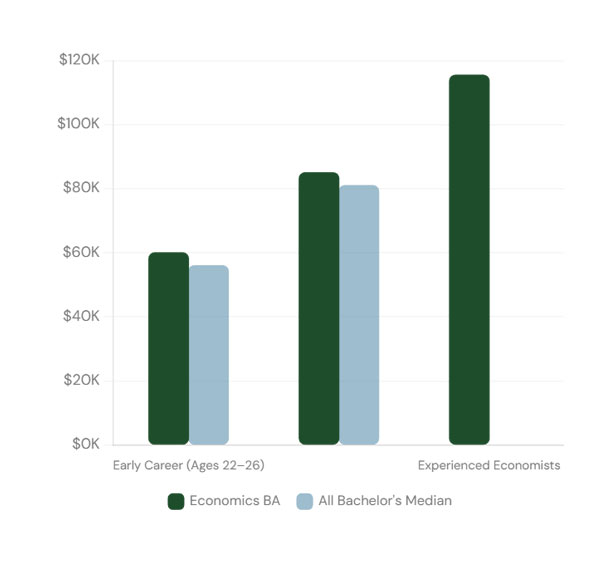
Source: Georgetown CEW, The Major Payoff (2025); BLS OES 2024. Early career = ages 22–26; Prime age = 25–54.
The CSU Advantage
Why Economics at Colorado State?
At CSU, economics isn't just supply and demand. As part of the College of Liberal Arts, you develop the interdisciplinary lens that the AI economy rewards most — understanding how culture, history, and institutions shape economic outcomes.
Our six elective tracks — from environmental economics to the economics of race, class, and gender — let you build domain expertise in areas where AI amplifies human insight rather than replacing it. When an algorithm flags an anomaly in climate data or labor markets, it takes a trained economist to ask why, to understand who is affected, and to design what comes next.
Through our Undergraduate Research Internship program, you'll work alongside faculty on real-world research — building the hands-on experience that separates you from a chatbot summary. The future belongs to those who can work with the machine. An economics degree from CSU is how you get there.
Economics at CSU: where critical thinking meets the machine.
The Fit
Economics Training Maps Directly to AI-Era Demand
Compare what the WEF identifies as the top growing skills against what you learn in our program.
Top Growing Skills (WEF 2025)
- Analytical Thinking
- AI & Big Data Literacy
- Creative Thinking
- Resilience & Adaptability
- Systems Thinking
- Curiosity & Lifelong Learning
- Leadership & Social Influence
Where You Build It at CSU
- Micro/Macro Theory + Econometrics
- Quantitative Track + Data Tools
- Political Economy + Heterodox Perspectives
- Liberal Arts Core + Interdisciplinary Electives
- International & Environmental Tracks
- Research Internships + Seminar Courses
- Writing-Intensive Capstone (ECON 492)
Ready to Build Your Future?
Compare what the WEF identifies as the top growing skills against what you learn in our program.